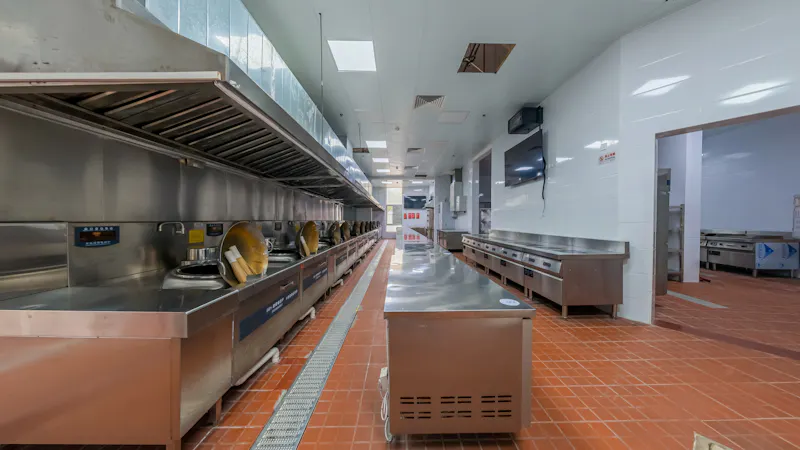
What Restaurant Hood Cleaning Involves
- Removal and hot-washing of baffle filters
- Degreasing of hood canopy interior, exterior lip, and plenum
- Interior duct cleaning from plenum to rooftop fan connection
- Exhaust fan blade and housing degreasing
- Grease drip rail and collection trough cleaning
- Post-cleaning inspection with before-and-after photography
- NFPA 96 certificate of completion for your inspection file
Your baffle filters need attention between full cleanings. See how our hood filter exchange service keeps filters performing on a set schedule.
How Often Your Hood Needs Cleaning
NFPA 96 sets cleaning intervals based on cooking volume and equipment type. High-volume solid-fuel cooking and wok operations require monthly service. Kitchens with heavy charbroiling or fryer use are cleaned quarterly. Standard range-and-oven operations typically require cleaning every six months. Light commercial cooking — cafeteria lines, snack bars, coffee operations — may qualify for annual service. If you are unsure of your interval, a technician can assess your system and grease accumulation rate and recommend the correct schedule.
The exhaust fan is part of the same cleaning cycle. Read about our exhaust fan cleaning service and why it cannot be skipped.
Why Grease Accumulates and Why It Matters
Every time your kitchen cooks, grease-laden air rises from the cooking surface and passes through the baffle filters into the ductwork. The filters capture a portion of that grease, but not all of it. Over weeks and months, grease deposits build on duct walls throughout the run to the rooftop fan. That accumulation is flammable. A duct fire does not stay contained — it travels up the shaft and exits at the roof, where it can ignite surrounding materials. Full cleaning of the entire exhaust path is the only way to eliminate that fuel load.
This is a well-documented risk across the industry, and hood cleaning professionals elsewhere in the country report the same duct fire patterns we see in Essex County kitchens.
What Affects the Cost of Hood Cleaning
- Linear feet of hood canopy (larger hoods take more time)
- Duct length and number of bends or offsets
- Degree of grease accumulation since the last professional cleaning
- Ceiling height and rooftop access conditions
- Number of exhaust fans connected to the system
When Not to Call Us
If your fire suppression system was discharged and needs recharging, that work requires a licensed fire suppression contractor. We document and coordinate but do not recharge suppression systems. If you need a new hood installed or your kitchen ventilation redesigned for a build-out, that is mechanical contractor work. We clean and degrease existing installed systems.